Jump to a question in this guide
- What should I do first if I notice possible rodent signs?
- How do entry, food and shelter work together?
- Which parts of the house are worth discussing as possible entry points?
- How do food, pet supplies and waste change the problem?
- What makes stored belongings and hidden spaces useful shelter?
- Can scratching, package damage or a photograph identify the animal?
- Why must suspected droppings or nesting material be handled differently?
- What should a pest investigation actually establish?
- How should I compare entry work, control and cleaning proposals?
- What changes in a condo, rental or Canadian region?
- How would a fictional owner turn three clues into one useful plan?
- What should follow-up show before the file is closed?
- Understand entry, food or water access and shelter as different parts of the prevention plan.
- Do not sweep or vacuum rodent droppings or disturb suspected waste to investigate it; obtain an appropriate assessment and cleaning scope.
- Connect each proposed job to an identified problem, with clear locations, limits and follow-up.
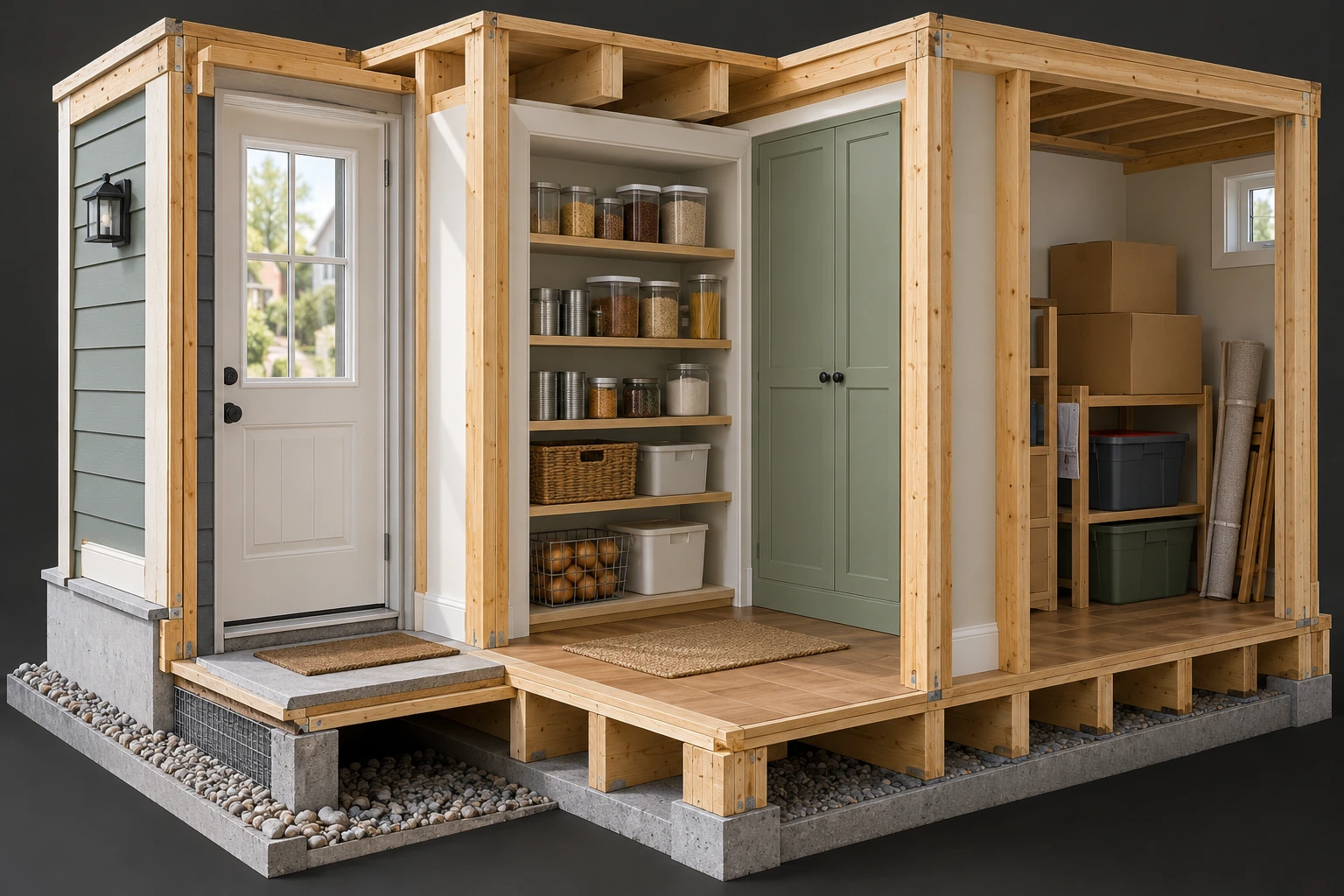
A rodent needs a way into or through the building and access to resources once there. The door, food shelf and storage nook give three familiar places to discuss. Notice that a tidy pantry can contain both closed jars and exposed food; appearance alone does not settle food access.
About this illustration
No animal, waste, nest, active route, infestation, contamination or repair result is shown. This is a comparison of locations and storage conditions, not a recommended pantry layout or pest identification. This is a conceptual teaching model, not an assessment of your home.
4 picture lessons appear beside the questions in this guide. Use them to understand the explanation, then consider what it means for your home.
What should I do first if I notice possible rodent signs?
Start with the place, the time and what you actually noticed. Scratching in a wall, a damaged food package or marks beside a door can raise a rodent question. They do not all tell you the same thing. A useful first account helps a pest professional decide what needs identification and what part of the home needs assessment.
If you see suspected droppings, urine or nesting material, stop treating that spot as ordinary housekeeping. Do not sweep or vacuum rodent droppings, disturb the material to get a better photograph or handle a nest to identify it. Keep people and pets from disturbing the area and obtain advice on an appropriate assessment and cleaning scope.
Use the observations you can make from ordinary, safe access. A room name and a photograph taken without approaching suspected waste can be useful; a photograph is not worth entering a crawlspace, reaching into a wall or climbing into an attic. Report concerns promptly rather than collecting a larger set of clues yourself.
This guide follows four practical questions: what is happening, how an animal could enter, what food or shelter is available, and what work would address the identified problem. It helps you understand a proposal and follow-up. It does not identify a species from a picture or provide a trapping, pesticide or contaminated-area cleanup procedure.
How do entry, food and shelter work together?
Entry is the way into a building. Food and water provide resources. Shelter is a place to hide or nest. These are different conditions, so a useful plan considers them together. Closing one opening does not address accessible food, and changing food storage does not establish that every entry has been found.
Think of three familiar locations: a worn junction beside a door, a pantry with stored food, and an unused storage area. They answer different questions. Could the doorway provide access? Is food contained? Does storage provide cover? An illustration can explain those jobs without drawing a confirmed journey through your house.
Health Canada and municipal guidance connect prevention with reducing easy entry, accessible food and nesting opportunities. That gives a practical reason to ask about the building and daily storage arrangements before choosing a treatment product. It is not a claim that clutter alone caused a problem or that a tidy home cannot have rodents.
The professional should connect the proposed work to a finding. For example, an identified entry concern calls for suitable exclusion work, meaning work intended to prevent access. A food-storage issue calls for an appropriate containment change. Suspected contamination raises a separate cleaning and exposure question.
Keep those explanations separate in the proposal. “Pest treatment” is too broad to tell you whether identification, entry work, storage changes, cleaning and follow-up are included. Ask which tasks are actually covered and which need another provider or the building manager.
Entry, food and shelter are different parts of the problem
A rodent needs a way into or through the building and access to resources once there. The door, food shelf and storage nook give three familiar places to discuss. Notice that a tidy pantry can contain both closed jars and exposed food; appearance alone does not settle food access.
Numbers identify the parts explained below.
- Building boundary
Doors and other junctions are places to discuss during an entry investigation. A nearby doorway does not establish the route an animal used.
- Food access
Closed containers and uncovered produce have different access conditions. Consider the actual intact storage and waste arrangements without handling suspect food.
- Sheltered storage
Unused boxes and stored items can create places to remain. Entry, resources and shelter need coordinated questions rather than one treatment product.
What does this illustration leave out?
No animal, waste, nest, active route, infestation, contamination or repair result is shown. This is a comparison of locations and storage conditions, not a recommended pantry layout or pest identification. This illustration explains an idea. It is not an installation guide.
What was identified at this home, and how will the proposed work address entry, accessible resources and shelter?
Explore this with HomeAI ↗Opens an editable question. Nothing is sent until you choose to send it.Which parts of the house are worth discussing as possible entry points?
A door meets its frame and threshold; a window meets its frame and surrounding wall; service pipes and vents pass through building surfaces. These junctions deserve attention because a building boundary is made of connected parts. A worn door junction is therefore a useful location to report, rather than a reason to buy a generic sealing product.
From stable ground and ordinary rooms, note where a visible opening or damaged junction is located. Include whether it is beside a moving door, fixed wall connection or service opening. The pest professional needs to determine whether it is relevant to the identified animal and whether the apparent opening actually leads inside.
Do not use the size or colour of a pictured gap as a verdict. A photograph may show the front of a junction while leaving its continuation hidden. An exterior mark and an indoor sound are not automatically connected. Ask what evidence supports the proposed entry location and what areas could not be assessed.
Repair work must preserve the other jobs at the junction. Doors still need to operate safely; designed openings and equipment terminations need their intended function. Do not cover a vent, fill an unfamiliar opening, alter a shared assembly or work around electrical equipment as an owner experiment.
Ask who should carry out each task. A pest professional may identify an access concern, while a door, envelope or equipment specialist may need to determine a suitable repair. The adjacent door and window guides explain their parts and operation; this guide owns the rodent enquiry rather than replacing those assembly lessons.
Investigate the boundary without blocking building services
A door, window and service crossing interrupt the wall in different ways. An entry investigation asks which actual junction matters and what its building function requires. It should identify the problem before choosing exclusion work—the work intended to keep pests out.
Numbers identify the parts explained below.
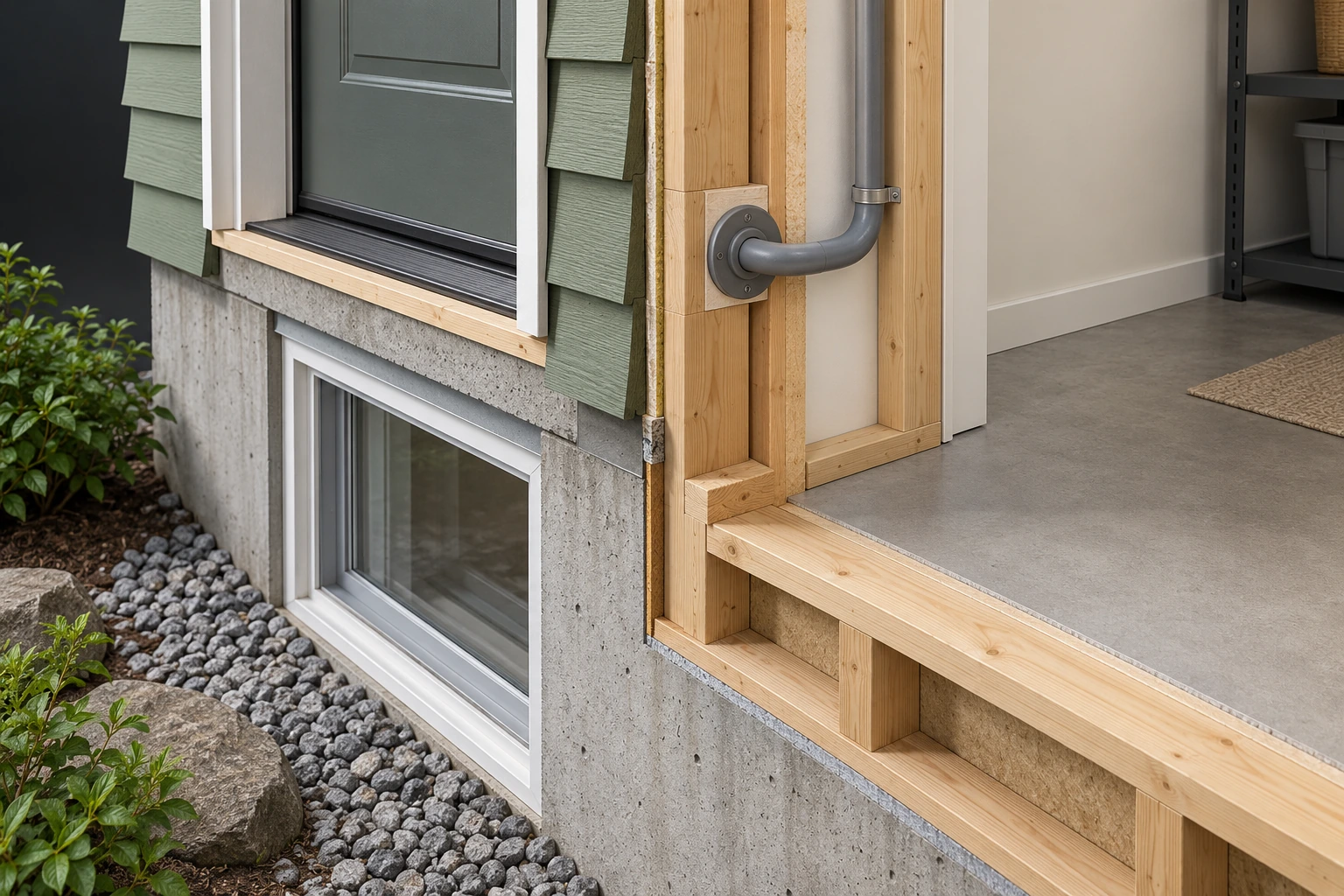
- Door threshold
The door must still open, close and manage its intended weather junction. Ask which actual gap or condition was identified before accepting a repair.
- Window frame
The window is a separate wall junction with its own operation and water-management jobs. A pest enquiry is not a reason to obstruct its intended functions.
- Service crossing
Have the responsible provider assess a service junction. Do not cover vents, open electrical equipment or improvise a seal around an unfamiliar service.
What does this illustration leave out?
The illustration establishes no opening size, animal passage, defective seal, pest identity or suitable repair. It does not depict a vent to close, authorize opening equipment, or supply a sealing detail. This illustration explains an idea. It is not an installation guide.
Which opening did the provider actually identify, and how will the proposed exclusion work preserve the building or service function?
Explore this with HomeAI ↗Opens an editable question. Nothing is sent until you choose to send it.How do food, pet supplies and waste change the problem?
Food access can involve more than the kitchen counter. Stored dry food, pet supplies, waste containers and outdoor food sources belong in the conversation. Vancouver’s examples include leftover pet food, fallen fruit and spilled bird seed. Toronto also connects rat prevention with food sources and securely stored waste.
For normal, unaffected storage, understand the job of the container and its closure: they separate the stored contents from access. A lid sitting loosely on a container is a different arrangement from a properly closed one. Ask the provider what changes are suitable for the actual items and where they are stored.
Keep routine prevention separate from a suspect item. If a package appears damaged or contaminated, do not taste its contents, empty it to search for clues or move it through the home as an identification exercise. Ask how that item and surrounding area should be handled under the appropriate contamination guidance.
Water access can also matter. A reported plumbing leak or persistently wet location deserves its own repair question. A pest visit does not diagnose the source of water, and a plumbing repair does not establish that the rodent concern is resolved. The relevant providers may need to coordinate their scopes.
Make the follow-up concrete: which normal storage arrangement changed, which waste container is used and which water concern was referred? That is easier to understand than an instruction to improve sanitation with no explanation of what the provider actually found. Avoid disturbing suspected waste while carrying out routine changes elsewhere.
Why one treatment does not explain the whole prevention plan
Entry, food and shelter can persist independently. Control directed at an identified pest and work on the building or stored resources therefore answer different questions. Ask the provider to connect each proposed task to an actual finding and a follow-up plan.
Numbers identify the parts explained below.
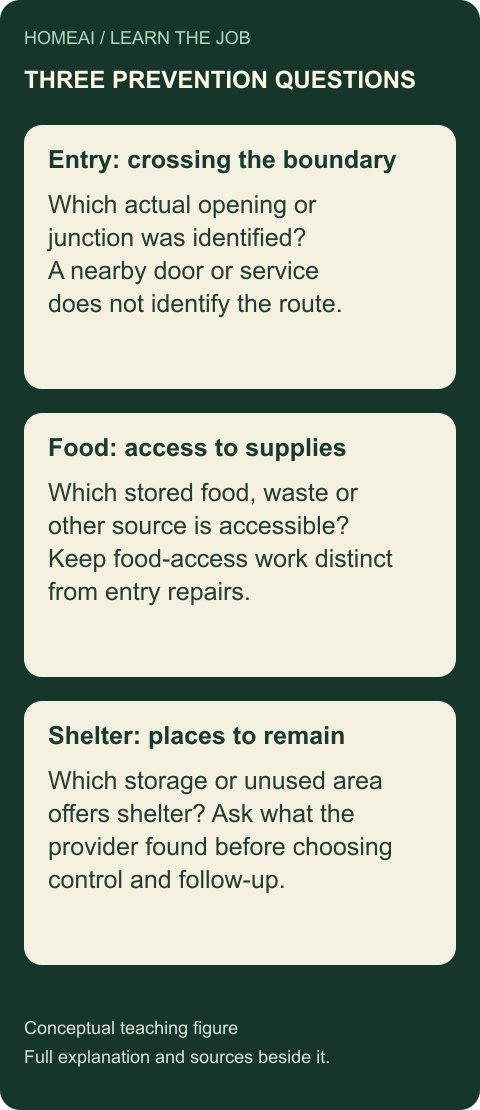
- Entry
Request the identified opening, inspected extent and appropriate repair scope. General proximity to a door does not identify passage.
- Food and water access
Ask which actual food, waste or other resource contributes. Keep routine prevention separate from handling suspect contamination.
- Shelter
Ask what storage or unused space was considered and what the provider recommends. A completed control visit does not by itself describe entry repair or resource changes.
What does this illustration leave out?
The cards are separate prevention questions, not a measured route or confirmed infestation. They give no pesticide, trapping or construction procedure. This illustration explains an idea. It is not an installation guide.
Which identified condition does each proposed task address, and what follow-up would show whether that task worked?
Explore this with HomeAI ↗Opens an editable question. Nothing is sent until you choose to send it.What makes stored belongings and hidden spaces useful shelter?
Shelter is the protected space an animal can use to hide or nest. Unused clutter, stored materials and dense areas beside buildings appear in public prevention guidance because they can provide cover. This is a different role from food: a storage area may offer shelter even when it contains nothing edible.
Ask about the specific place rather than labelling the whole garage a cause. Which ordinary storage arrangement is relevant? Which part was assessed? Is a recommendation about access to the building, sheltered space beside it or belongings inside? Each answer changes the work being proposed.
A hidden location is also an access limit. Noises above a ceiling do not justify opening the ceiling or entering a tight space to look for a nest. Ask what safe assessment methods the provider can use, what additional specialist access may be needed and what uncertainty will remain.
If belongings or insulation may be contaminated, ordinary decluttering is no longer the right instruction for that area. Leave the material undisturbed and ask for a separate handling and cleaning scope. Do not bring suspect boxes into a living area or shake materials out to make the space easier to inspect.
After appropriate work, keep the description of the changed arrangement with the record. Removing identified shelter and closing an identified entry are separate tasks. Neither should be recorded as the other, and neither alone guarantees that all current activity has ended.
Can scratching, package damage or a photograph identify the animal?
A sound tells you when and where someone heard something. A damaged package records damage noticed at a particular time. A photograph records a visible surface from one viewpoint. These are useful clues, but they do not each identify species, number of animals or the complete route into a building.
Keep the wording close to the observation. “Scratching heard near the rear kitchen wall after dinner” is clearer than “mice living in the wall.” “Package found damaged; time of damage unknown” is clearer than an invented date of entry. You can be specific without claiming a cause you have not established.
Separate clues by location before combining them. A pantry package, a sound in another room and a worn door junction may be related, or may need separate explanations. Ask the provider what connects them. Do not assume a straight line between the three places just because they appear together in a teaching image.
Identification changes which work makes sense. Health Canada explains that the type of pest matters to control choices. Ask what the provider identified, on what basis, where the evidence came from and whether the finding is tentative. A supplied photograph should retain its date, location and stated interpretation.
Do not handle droppings, create bait experiments, add tracking powders or deliberately leave food out to resolve uncertainty. A professional can explain the appropriate assessment scope. Your role is to supply a clear account and avoid turning an ordinary observation into a hazardous identification exercise.
Keep the observation separate from the conclusion
- A sound at a stated time and placeUseful location and timing; it does not identify the species or establish a hidden nest.
- A damaged packageRecords damage noticed; its cause and timing may still be unknown.
- A photograph of a junctionShows the visible viewpoint; it does not establish the complete route into a building.
- A provider’s findingRetain its basis, location, assessed extent and uncertainty.
Conceptual evidence roles, not a diagnosis of an animal, infestation or property condition.
Further reading: Health Canada · Rats and mice.
Why must suspected droppings or nesting material be handled differently?
The concern is not simply that a surface looks dirty. PHAC explains that disturbing infected rodent waste or nesting material can release particles that people may breathe in; contaminated objects and food can also be exposure routes. This is why a vacuum or broom is not an appropriate first response to suspected rodent droppings.
Do not sweep or vacuum rodent droppings. Avoid contact with suspected waste and nesting material, and keep others from disturbing it. Do not move a pile, test whether it crumbles, or collect it for a close-up photograph. The next task is to obtain an appropriate assessment and cleaning plan, not produce more evidence by handling it.
Ask where contamination is suspected, what access is needed, who will undertake the cleaning and what safety and disposal guidance applies. PHAC advises considering a professional cleaning company for heavily infested or contaminated areas. A pest-control proposal should make clear whether that cleaning is included or needs a separate provider.
This guide gives no disinfectant ratio, respirator selection, waiting time or disposal sequence. Use current applicable public-health guidance and qualified advice for the actual area. Do not combine fragments of an older pest page and a newer health page into a home cleanup recipe.
A suspect material or a rodent sighting is not a personal infection diagnosis. This guide cannot assess an individual exposure or symptoms. Seek a health professional’s advice about a health concern, and describe any possible exposure without assuming that a species photograph establishes a medical risk.
Suspected rodent waste changes the next step
Routine prevention concerns intact storage and ordinary accessible building conditions. Suspected droppings or nesting material need a different response: do not sweep or vacuum droppings or disturb suspected nesting material. Obtain the appropriate contamination and cleaning scope rather than disturbing the material to identify it.
Numbers identify the parts explained below.
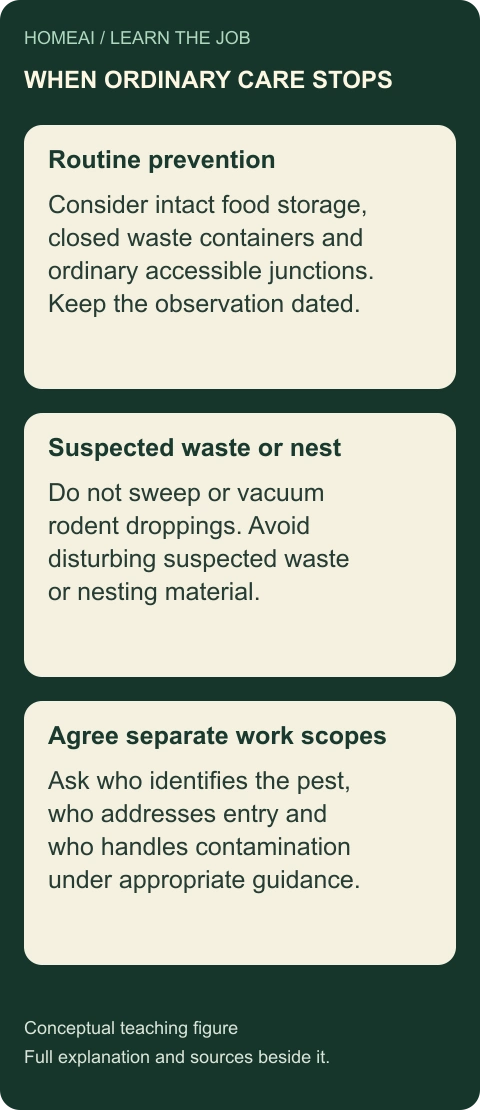
- Routine prevention
Use ordinary safe access to discuss intact food storage, waste containers and boundary conditions. A prevention task is not a contamination cleanup.
- Suspected waste or nesting
Keep people from disturbing the area. PHAC warns against sweeping or vacuuming rodent droppings; avoid disturbing suspected nesting material too.
- Separate work scopes
Ask who identifies the concern, who handles entry/control work and who addresses contaminated material. Keep the responsibilities clear.
What does this illustration leave out?
No disease risk at an actual property, clinical diagnosis, disinfectant, protective-equipment selection or cleaning procedure is supplied. Read current PHAC guidance and obtain suitable professional advice for the circumstances. This illustration explains an idea. It is not an installation guide.
Who will assess and handle the suspected contamination, separately from pest identification and entry work?
Explore this with HomeAI ↗Opens an editable question. Nothing is sent until you choose to send it.What should a pest investigation actually establish?
Begin with an identification question and a scope, not a promised result. Give the provider the original observations, the locations, known earlier work and any shared-building contact. Ask which areas they will assess safely and what access is outside the visit.
Integrated pest management, often shortened to IPM, joins identification, prevention, suitable control and follow-up rather than relying on one product. B.C.’s education explains those connected stages. Ask the provider to show how their plan applies them to this home, while keeping local requirements and the actual finding separate.
The report should distinguish what was observed from what was concluded. If the provider identifies a rodent or relevant sign, ask for the basis and location. If an entry is suspected, ask what supports that interpretation and whether its continuation was assessed. A confident label is less useful than an explanation you can connect to the work.
Then connect the finding to the home: possible entry, accessible food or water, shelter and any contamination. Not every job is the same trade. The provider should explain whether pest control, building repair, plumbing or contaminated-area cleaning requires separate arrangements.
Ask what the proposed control is meant to accomplish and what follow-up will assess. Identification and prevention remain important even when a control device or treatment is proposed. Do not assume that placing a product means entry work and cleaning were included.
For a product-based proposal, request the product identity, applicable label directions and the provider’s explanation of suitability, safety and responsibilities. Do not copy another property’s pesticide or trap arrangement. This guide recommends no poison, bait, trap position, application rate or work interval.
How should I compare entry work, control and cleaning proposals?
Compare proposals by the questions they answer. Identification establishes what the provider believes is present. Exclusion work addresses access. Control addresses the identified animal problem. Cleaning addresses contaminated materials or areas. Follow-up checks the stated outcomes under an agreed scope.
Ask each provider to name included locations and exclusions. Does “seal entry points” refer to two identified junctions or an assessment of the whole accessible perimeter? Does “service visit” include a written finding? Is a hidden space still inaccessible? Clear boundaries make two prices more meaningful to compare without choosing the cheaper wording.
For building work, request the proposed repair and the responsible specialist. The pest question should not lead to blocking an equipment vent or compromising a door’s operation. If a task affects shared property, obtain the building’s coordination and authorization procedure rather than treating one unit’s proposal as permission.
For cleaning, ask whether suspected contamination was assessed and who is responsible for that scope. A general housekeeping service and a contaminated-area plan are not interchangeable descriptions. Keep the handling limits in force until the responsible provider explains the next step.
Agree the follow-up before accepting the work: what will be checked, what record you receive and whom to contact if a sign returns. A guarantee, if offered, needs its actual written conditions. This guide supplies no eradication promise, standard warranty or predicted cost.
Match the proposed job to its purpose
- IdentificationEstablish the provider’s finding and the evidence supporting it.
- Exclusion workAddress identified access locations with suitable building work.
- ControlAddress the identified animal problem under the appropriate scope.
- Contaminated-area cleaningAddress suspected waste and affected materials under applicable safety guidance.
- Follow-upCheck the agreed scope and record findings and remaining limits.
Jobs may need different providers. No treatment method, building specification or result is approved by this comparison.
Further reading: Health Canada · Rats and mice; Public Health Agency of Canada · Hantavirus: spread, prevention and risks.
What changes in a condo, rental or Canadian region?
A unit is part of a larger building. The location of a reported sign and the area needing work may involve different people or assemblies. Tell the owner or building manager what you noticed and ask who coordinates assessment, common-area work and access. Do not alter shared openings or assemblies yourself.
Toronto’s current page directs multi-residential concerns first to the landlord, owner or property management, with a local reporting route if unresolved. Vancouver separately describes contacts for private homes, City property and food premises. These examples show why the correct contact depends on the setting; they are not a nationwide allocation of legal cost or responsibility.
Species and conditions also vary by region and nearby habitat. Vancouver’s local species description cannot identify an animal in a Prairie home. Federal guidance does not establish neighbourhood prevalence, an infestation at an address or a Canadian species map.
Health Canada’s older page mentions possible fall entry by deer mice near fields and woodlands. That supports seasonal awareness in that context, not a measured increase in 2026 or a current local outbreak. A neighbour’s report or competitor article is also not evidence of search demand or of what is happening in this home.
Use current local public-health, pest, waste and building information for questions that depend on place. Retain the source and date when a provider explains a local requirement. This guide provides national education with named municipal examples, rather than a checklist of unverified provincial rules.
How would a fictional owner turn three clues into one useful plan?
Fictional owner Alex finds a pantry package damaged. Alex does not know when it happened. Later, scratching is heard near a rear room, and an ordinary ground-level photograph shows wear at a door junction. No animal is identified, and no connection between the three observations has been established.
Alex records the package’s location and discovery date, the sound’s time and room, and the door photograph’s location. Suspected waste, if noticed, is left undisturbed. The service brief asks the provider to identify the concern and assess whether the pantry, sound and doorway are related.
The proposed work is divided into useful tasks: identification and access limits; any relevant entry repair; normal food and storage changes; an appropriate contamination assessment; and follow-up. Alex asks which tasks are included and which need a building specialist or cleaning provider.
Suppose the provider later reports a finding at one junction. The record should state its basis and extent, the proposed repair and what remains unknown. It should not silently convert that finding into proof that every other clue has the same cause. Any completed work then gets its own dated location and scope.
The example ends with questions and records, not an invented catch count or a pest-free certificate. A later absence of noticed scratching may be welcome, but the agreed follow-up still needs to state what was assessed. No actual infestation, contaminated food, infection, successful treatment or repair price is claimed.
What should follow-up show before the file is closed?
Keep the original concern, assessment, proposal, completed work and follow-up as separate dated records. That lets the next person see whether a recommended entry repair happened, whether cleaning was a separate task and which locations were never accessed.
A completion record should name what was done and where. A follow-up should explain what was assessed, what evidence was found and what limitations remain. A visit date or invoice establishes a recorded service, not that every possible opening was closed or the home is permanently pest-free.
If signs recur, report the specific new location and timing alongside the earlier record. Do not assume the same cause, and do not disturb suspected waste to compare it with an old picture. Ask whether the earlier control, building repair, storage arrangement or assessment scope needs review.
At handover or sale, provide the actual reports and completion records rather than a broad assurance that a problem was fixed. Explain any ongoing tasks or unresolved access. Disclosure and legal questions need the appropriate local advice; this guide does not determine them.
The aim is an understandable account: what was noticed, what was identified, which conditions were addressed and what happens next. That gives routine care and professional follow-up a shared purpose without turning a conceptual house picture into evidence about a real home.
What should the complete record explain?
- Original observationWhat was noticed, where and when, without a diagnosis.
- AssessmentWhat was identified and which locations were assessed or inaccessible.
- Proposal and completionWhat was agreed and what work actually happened at named locations.
- Follow-upWhat was checked later, what was found and which questions remain.
A record organizes the work; it is not a pest-free, medical, safety or legal certificate.
Further reading: Health Canada · Rats and mice; Public Health Agency of Canada · Hantavirus: spread, prevention and risks.
Keep learning about the connected parts
- Entry doors and thresholds: understand changed operation and weather evidence
- A sticking window: understand the parts before replacement
- Crawlspace moisture: build evidence without going underneath
- Build a home-care record that the next person can understand
- Water leaks explained: find the right question before the repair
- Read an inspection report without turning it into a guarantee
- Bedbugs: understand identification, treatment and follow-up
- Wood-destroying insects: separate the pest, moisture and structural questions
- Wildlife entering roofs and attics: identify the route before repair
Canadian context and authorities · Visual atlas · Learning labs
Practice the distinction.
Three clues before an animal is identified
Fictional Alex notices a damaged pantry package, a sound in another room and wear at a door junction. Their relationship is unknown.
Reported observations
- The package’s discovery date is known; the time and cause of damage are not.
- A scratching sound was reported at a stated time and location.
- An ordinary ground-level photograph shows a worn junction without proving an entry route.
Compare the explanations
Expand each possibility to see the evidence needed to distinguish it. Similar symptoms can have different mechanisms.
Some clues relate to a rodent concern
The provider needs identification evidence and a scoped assessment before connecting the locations or choosing work.
A report stating what was identified, where, on what basis and with which access limits.
The clues need separate explanations
A package, a sound and a worn building junction do not have to share a cause.
Separate dated observations, relevant provider findings and clearly stated unresolved questions.
A useful next question
Request identification and separate entry, storage and contamination scopes without disturbing suspected waste.
Fictional only. No actual animal, infestation, infection, treatment result, guaranteed exclusion or legal disclosure conclusion.
Know what the words mean.
- Rodent sign
- An observation such as a sound, mark or damaged package that raises a rodent question. Its meaning needs identification and context.
- Entry point
- A place where an animal may gain access to a building. A visible opening needs assessment before it is treated as a confirmed route.
- Attractant
- A condition such as accessible food or water that may support activity; it does not identify an animal or establish the cause by itself.
- Shelter
- A protected place an animal may use to hide or nest, separate from its food source.
- Nesting material
- Material used for a nest. Suspected rodent nesting material should not be disturbed for a closer owner investigation.
- Exclusion work
- Work intended to prevent animal access through identified locations while preserving the building’s other functions.
- Contamination scope
- The locations and materials considered in an assessment and cleaning plan for suspected rodent waste; distinct from choosing pest control.
- Identification finding
- The provider’s stated conclusion about the animal or sign, with its evidence, location and uncertainty.
- Integrated pest management
- An approach joining identification, prevention, suitable control and follow-up; often abbreviated IPM.
Questions to bring
to the conversation.
- What did I notice, where and when, without assuming species or a complete route?
- Which visible junction, food arrangement or storage location is actually relevant?
- Is suspected waste present, and who will assess the contamination and cleaning scope?
- What evidence supports the provider’s identification and proposed entry or control work?
- What will the completion and follow-up records explain, and what remains inaccessible?
Separate a showing observation, an existing record and a new professional assessment. Unknown means a question remains; it does not automatically mean a defect.
Use the evidence planner ↗Go to the source.
Original HomeAI explanation informed by these public references. Sources support the underlying guidance; they have not reviewed or endorsed HomeAI. Diagrams are conceptual, and calculator outputs depend on your inputs.
Canadian education with federal sources, named Vancouver/Toronto examples and B.C. IPM context, reread October 9, 2026. Health Canada’s pest page retains its 2016 date; PHAC’s prevention page is dated July 29, 2026; B.C.’s page is dated January 20, 2023. Local species, reporting, building authority and provider scope need separate confirmation. No measured seasonal demand or 2026 rodent surge, species diagnosis, owner treatment, cleanup recipe or guaranteed result is supplied.
Publication & source review
First published .
Sources reviewed .
- Health Canada · Rats and mice
Where this reference applies
Jurisdiction: Canada; federal public pest-control education
Edition: Page details 2016-12-06.
Source reviewed: 2026-10-09 · America/Edmonton
Signs, identification before choosing control, entry/food/shelter relationships and product-label boundaries. This guide gives no species diagnosis or treatment procedure. For suspected waste, use the separate current PHAC prevention guidance.
- Public Health Agency of Canada · Hantavirus: spread, prevention and risks
Where this reference applies
Jurisdiction: Canada; public-health prevention guidance
Edition: Page details 2026-07-29. This date does not establish a local outbreak.
Source reviewed: 2026-10-09 · America/Edmonton
Avoid contact with rodents and waste; disturbing infected waste or nesting material can release harmful particles. Do not sweep or vacuum rodent droppings. Professional cleaning may be appropriate for heavily infested or contaminated areas. This guide provides no personal infection diagnosis or cleanup procedure.
- City of Vancouver · Rats and mice
Where this reference applies
Jurisdiction: Vancouver, British Columbia; municipal examples only
Edition: No substantive modification date established; 2026 copyright is not an edition.
Source reviewed: 2026-10-09 · America/Edmonton
Entry, food/water and shelter prevention relationships, with local reporting examples for private homes, public areas and food premises. Vancouver’s species and service information cannot identify the animal or determine the reporting route elsewhere.
- City of Toronto · Rat control
Where this reference applies
Jurisdiction: Toronto, Ontario; municipal examples only
Edition: Date modified 2026-09-03.
Source reviewed: 2026-10-09 · America/Edmonton
Waste, food and shelter prevention, plus the local direction to contact a landlord, owner or manager first for multi-residential concerns. Toronto’s reporting route and response plan do not establish national duties, legal costs or this home’s condition.
- Province of British Columbia · Managing rat and mouse pests
Where this reference applies
Jurisdiction: British Columbia; provincial IPM education with historical page date
Edition: Last updated January 20, 2023.
Source reviewed: 2026-10-09 · America/Edmonton
Integrated pest management connects identification, prevention, appropriate control and follow-up. This guide uses that relationship without transferring provincial pesticide rules or treatment instructions. Current PHAC health guidance stays separate.
Have a question about your home?
Start with the symptom, timing and what you have observed.
Ask HomeAI